At War with Rising Up and Rising Down - Introduction

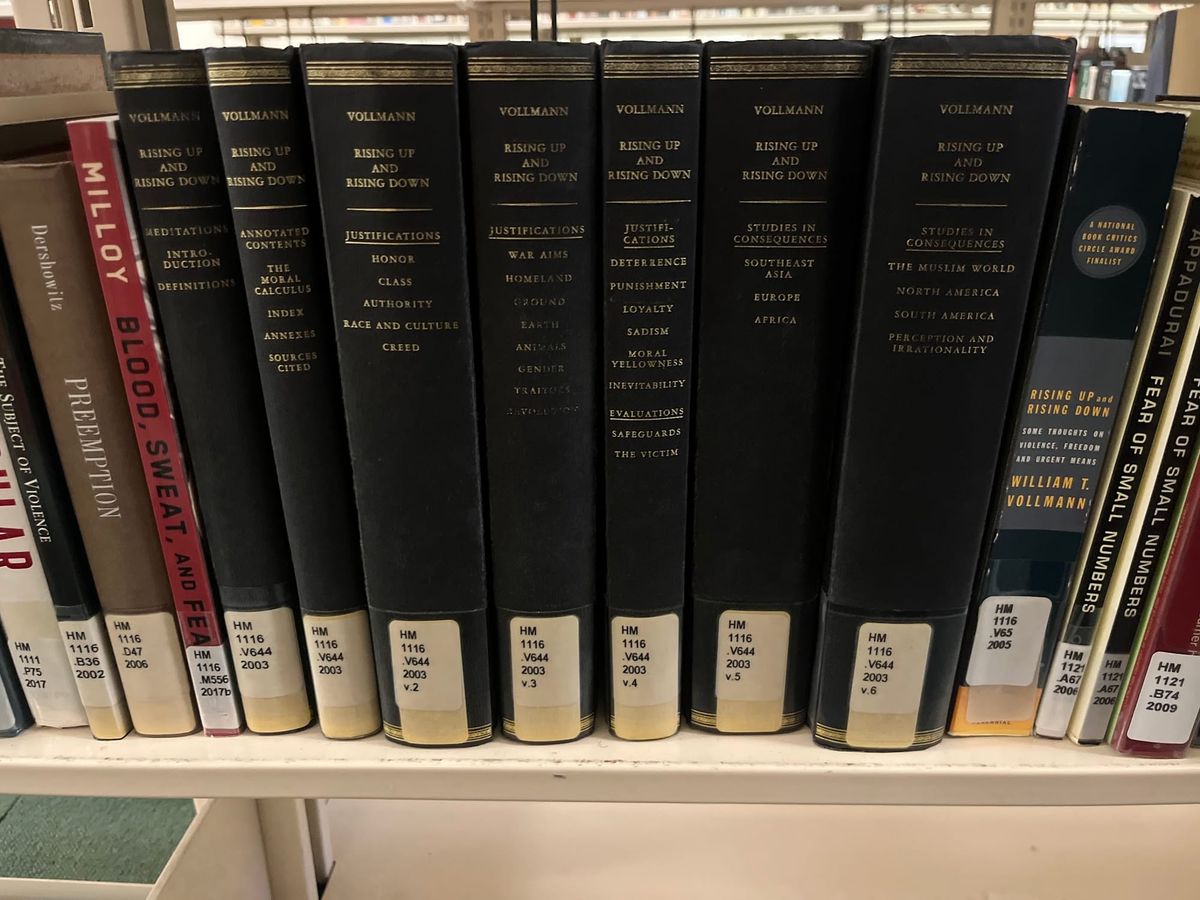
The story of how someone finds their way to Rising Up and Rising Down is not as interesting as the book itself, but because of its scarcity it's at least a little more interesting than your average Kindle purchase. To wit:
I'll admit to being something of a closet Redditor. I have an account, but I don't comment and I don't post. I just check the website periodically for questions that don't need answers or for a way to kill time at work that doesn't involve the time investment of reading a book. Most subreddits are total wastelands, of course—echo chambers filled with bad faith, ornery, entitled interlocutors—but it's less the content and more the form of delivery: it goes down easy. So, in an effort to preserve a sense of literary pretension while avoiding the actual work of being literary, I occasionally peruse r/RSbookclub. It's worth noting, mostly for my own sense of self-worth, that while I do know who Dasha Nekrasova is, I've never listened to Red Scare nor otherwise have any relationship to the podcast. It's my understanding that the subreddit also bent away from it a while back.
A post cropped up that was the kind of empty calorie catnip perfect for looking at behind the wheel of a cash register: what's a sign that the used bookstore you're in is the real deal? Someone mentioned that if they have Gaddis, Sebald, and Vollmann on the shelf, they're legit. Gaddis I love, and Sebald is at the very least a name I know and understand I am supposed to respect. But Vollmann? I had never heard that before. Not even in the back of my mind spurned by a little Googling did a recollection of William T. Vollman emerge–this was some tabula rasa shit. And he seemed to have an eclectic bibliography stuffed with ambitious, maximalist work; just my cup of tea. I had been looking for something substantial to sink my teeth into since coming down from the summit of The Recognitions last year, and there was no shortage of girthy work to choose from. I could have submerged myself into the historical Seven Dreams novels, I could have microdosed with a book of short stories like The Atlas, or I could have gone straight for (per the copy on the paperback’s front cover, at least) his most welcoming masterpiece, Europe Central.
But when Rising Up and Rising Down popped up, I knew that was the first Vollmann I needed to read--and I knew I needed to read it in its entirety. A gargantuan seven-volume exploration of violence and its justifications: an essay in the Montaignian sense, but really, really, really long. I was drawn to it primarily for its scope and the archetypal nature of its subject. Violence is all around us. It always has been, and (sadly) probably always will be, but it feels as if it’s reached a fever pitch at this particular juncture in American history. There’s an interesting line toward the beginning of Volume I: “Violence no longer hovers over the ballot box in American cities; it’s in other lands.”
This was likely more true in 2003 than it is in 2026, but there’s still some truth in the spirit of the claim. The American Id has been exported–primarily to the Middle East–and pops up at home only in isolated fits of gruesome political violence. There is no Guns N’ Roses, or Eminem, or N.W.A or Cormac McCarthty or Flannery O’Connor or Willim Faulkner or Barbara Loden or Martin Scorsese or Spike Lee to express it and serve as a release valve for the pressure building in our contemporary moment. Violence is in our zeitgeist—in some ways it is our zeitgeist—yet we have no means of addressing it, and I’ve grown increasingly frustrated with the social contract that tells us to nod our heads with solemnity toward acts of violence and just move on. The October 7th attack and Israel’s ensuing US-backed genocide on Gaza, for example, or its US-backed war on Iran and its US-backed war on Lebanon; the assassination of Brian Thompson and the assassination of Charlie Kirk; two unsuccessful attempts at the life of Donald Trump during his presidential campaign in 2024; the murders of Alex Pretti and Renee Good in Minneapolis at the beginning of 2026. This is but a short list of the seemingly endless acts of violence we’ve witnessed in the last half decade. (Is any of the above justified? Too early to say.) We have access to so much information about violence, but we can’t properly digest it. Death, death, death, death, and death. It is as common as the cold, and treated as such.
Thus, the slow work of reading a 3,200 page essay on violence takes on a greater meaning. As fascism rises (and yes, we must call it fascism, for if we don’t it will continue to grow and fester in the corner like mold until finally the whole living room of our lives is covered in it and like that fish in the David Foster Wallace speech we ask, “What the hell is mold?”) and reactions to it become increasingly violent in kind, there is great value in reflecting on violence, when it has been used, and why.
I set out searching for a set online, but I couldn’t find any for less than $800. I've been known to shell out more than I should for a rare book, and I'm not ashamed to admit I would have happily financed it if I could have found it for around $500. It's just not going to happen unless the set is extremely damaged: as I write, several sets have gone up for sale on eBay, none of which are even remotely reasonably priced.
Is Rising Up and Rising Down worth the price? Impossible to say. Worthwhile? Just might be. So few people will read it that to slap a dogmatic label like necessary or essential or important feels useless, but worthwhile–that’s something. Maybe even enough. And a book that is worthwhile–a book that is enough–is worth going to war with (or against, or perhaps for–pick your preposition). Worth finding.
I’m nothing if not persistent when I really want something: I will pursue it to the bitter end. To a fault and to my detriment, if need be. Buying the book was out of the question (a great temptation, a terrific distraction, but out of the question), so I had to explore other avenues of procuring it, i.e., the only one: the library. The NYPL didn’t have the unabridged version, only the abridged. It wasn’t in the system at the Queens Public Library, and in Brooklyn they only had volumes IV and V. But I graduated from college! Surely my tuition dollars could work for me in retrospect by getting me access to the library at NYU, where the books are languishing and collecting dust on the shelf. I was a Bobst diehard in my time; they’d reward me for that, right?
Not a chance. Alumni were barely allowed in the building, let alone allowed to check books out. How dare an inquisitive alumnus continue their education! Not on their dime! But I am not only a college graduate, I am a lucky man. I have a girlfriend. (How many readers of Rising Up and Rising Down have girlfriends, I wonder? It sounds almost jockish in this context.) Not only do I have a girlfriend, but that girlfriend is in graduate school. With some obsessive prodding and the purchase of a dress as a token of gratitude, I was able to convince her to take me to Queens College, where she attends their MLS program, to wrangle the beast. I was not allowed in the library proper, so like a secret agent she infiltrated the premises while I waited in the lobby tapping my foot, listening to Shoshtanovich and praying (yes, praying) they would actually be there.
“I can’t find them,” she whispered to me over the phone.
I reiterated the call number. The library was about to close. The stakes couldn’t have been lower, but for me it was like waiting to see if Nic Cage could steal the Declaration of Independence.
“I got them,” she continued.
She hung up the phone and was back downstairs within minutes. I finally had them in my hands. Leather-bound, black-spined–ominous, inviting things. The moment was actually quite moving for me: my partner was willing to go out of her way, on a cold late winter morning, to check out this rare book that few people own and even fewer have read, languishing on the shelf at this institution of higher learning (the last checkout for Volume I was in September 2015, and before that September 2009). She did me a great kindness.
The title of this essay, At War with Rising Up and Rising Down, has (from where I’m standing) two meanings. The most obvious is as of this writing America has joined its conjoined twin Israel in an unjustified and hideous war against Iran–it’s what mostly precipitated my reading of the book. The second is derived from the oral history for the book’s publication at McSweeny’s. “To read it,” editor Gabriel Roth says, “is to argue with it.” The reader, in picking up one of its seven volumes (or even the abridged) is choosing to brandish her sword and go toe-to-toe with the Hercules of American letters. Who emerges victorious? Only one way to find out.
I can’t promise what I will write here, an informal attempt to wrestle with a subject that grows more urgent with each passing day–an essay on an essay on violence–will resemble anything comprehensive. It will be more emotional than analytical, a reflection on the experience of reading it more than an exegesis of its contents. But I can promise that it will be honest. It’s all one has. Don't forget to thank your local librarian.
P.S. - As of publication (4/21/26) I've read volumes one and two in their entirety and expect to share my thoughts on them. I have, however, also been wrestling with my mental health since I started reading Rising Up and Rising Down and needed to put it down to focus on taking care of myself. I hope to finish the project, but safety comes first.

![FJORD (2026, Mungiu) [NYFF Review]](https://storage.ghost.io/c/4f/e6/4fe6b221-8357-41b8-a6fb-14698168315c/content/images/size/w600/2026/09/image-1.png)