Resident Evil (2026, Cregger)

Like most nerds who grew up in the 2000s, I had a relationship with Resident Evil. I was first exposed (as it were) to it via my babysitter's brother Keith, who I caught playing Resident Evil 2 on a plastic-covered couch in his family's den one day after school. I later played RE4 on Playstation 2, but I can't say I became a true fan of the franchise until much later; it wasn't until they soft-rebooted the series with RE7: Biohazard that I got way into it. Some of my fondest college memories involve playing Biohazard with different groups of friends, shouting and screaming at the TV; I went back and played the 2 and 3 remakes during COVID; and I watched Video Game Dunkey stream Resident Evil: Village while working a thankless remote job. Resident Evil has been around at nearly every stage of my life.
All of which is to simply establish my relative bona fides as someone who likes the games and was primed to enjoy Zach Cregger's new adaptation of the IP, his third in an ongoing series of films meant to try and make us forget he directed Miss March back in 2009. It is, frankly, a failure as an adaptation of Resident Evil: completely misreading the franchise's zanier proclivities as opportunities to insert his own brand of condescending humor; pandering to the Very Online crowd with dog-whistles planted to arouse nods of approval and remarks of "Exactly" in the theater; and simulating the experience of watching someone stream a video game with snarky color commentary rather than transposing the original's tone and mood into film form. I was never super high on Cregger, but I liked Barbarian and Weapons. Now, I see the ruse.
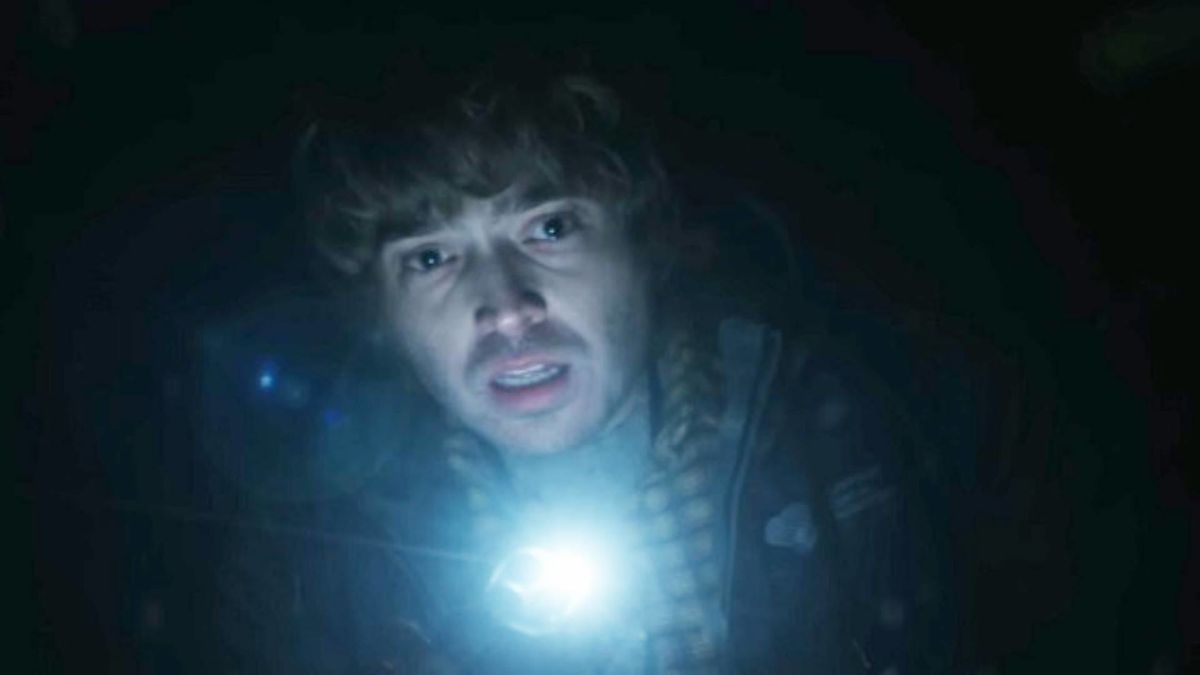
Resident Evil (2026) begins in medias res behind the shoulder of hapless medical courier Bryan, a perfect case study in the straight white American male of the 2020s: potty-mouthed, irreverent, and raging against the indifferent world around him. There is perhaps buried deep within Resident Evil (2026) a critique of this kind of man, but if there is it's too deeply obfuscated by the pleasure Cregger clearly takes in hanging out with him. There's far too much pleasure to be derived in seeing him succeed as he acclimates to the understanding that the world is about to be taken over by zombies.
Resident Evil (2026) is structurally impeccable, I’ll admit: a problem is presented, Bryan discovers a solution, only to have that solution present yet another problem. It’s a perfect case-in-point for the South Park But/Therefore screenwriting formula–the thing is tight as a drum. Firing the pistol he acquires and killing his first zombie, for example, but that bullet punctures his car’s engine, therefore he has to wander into the lone farmhouse sitting in the distance, is a great moment. (Having the title card drop right after, however, is egregious).
I appreciated, too, Cregger's willingness to expose and explore human anatomy. There are a lot of innards here: intestines and sacs and spleens and hearts; all matter of viscera are on full display. Yet none of it is disturbing. Early in the film, a child has been infected by one of her parents, bitten in the foot and left for dead. It’s a powerful juxtaposition: the innocence of youth poisoned by a virus that turns her toes into a curling mass of disgusting tentacles. What does Cregger make of the moment? He has Bryan shoots the girl the moment she turns. It's cruel in a way that may have been perceived as awesome sauce in 2011, much in the same way some freaks thought it was cool if you could endure A Serbian Film. He wastes the horror of dealing with the fact that his protagonist just killed a kid. There’s so much death and blood and none of it is upsetting in the least. Resident Evil (2026) not only fails as a Resident Evil adaptation, it fails to clear the bar of any horror movie. It’s just a comedy with more violence.
Particularly in the early going, which is shot with the sophistication of a broad 2000s comedy, just with darker cinematography. Frames are open, clean, and empty; they remind us that Cregger comes from the comedy world not just as a writer but also as a director—most of the action is played in master shots. The film opens up when it gets to Raccoon City, and the run-n-gun centerpiece featuring Bryan running in the street, all the zombies are on the rooftops and they fling themselves to attack him and wind up splattering on the side of the road.
Any goodwill Cregger buys in the back half of the second act, however, is thrown out a 28-story window with the film's climax: a bellow of cheap nihilism the likes of which have become commonplace for the contemporary horror film. It's perfectly of our moment in the worst possible way: "Nothing is earnest," it whispers, "It’s OK to laugh." If nothing is earnest, then nothing, really, is worth fearing. I don't want my horror movies to placate me--I want them to scare me.

![The Odyssey [Round Two] (2026, Nolan)](https://storage.ghost.io/c/4f/e6/4fe6b221-8357-41b8-a6fb-14698168315c/content/images/size/w600/2026/08/christopher-nolan-odyssey-02.webp)